Tracy Thrower Conyers is a long-time resident of Westchester 90045. Tracy closely follows local politics, political players and social chatter relevant to Westchester. You’ll frequently find her at Neighborhood Council meetings, as well as on all the social platforms where 90045 peeps hang out. Tracy loves a good conversation about our community, so don't be shy about leaving comments. 😊
SB-79, that terrible bill that wants to put 15,000’ high-rises on the 5K’ lot next door.
What a week.
Back in March, City Councilman John Lee made a motion to the City Council to take a position against SB-79 unless amended to exempt municipalities with state-approved and compliant Housing Elements, like LA. The motion was seconded by our very own Traci Park.
The president of the Council ignored the motion and then “accidentally” agendized it this week. He copped to this in a bizarre opening statement at the council meeting on Tuesday where the motion was finally taken up.
Despite the fact that LA worked for two years through multiple public hearings and countless public comments to approve its Housing Element, and further despite the fact said Housing Element was unanimously approved by the City Council, five councilmembers, including the President voted NO to standing up against Sacramento and fighting for local control.
Nevertheless, the motion passed 8-5 with some very powerful statements by councilmembers. Watch those statements here.
Traci Park also held a press conference beforehand. Watch her remarks here. Fun fact! You can’t see me, but I’m standing just to the left of Monica Rodriguez (pictured next to Traci) at the press conference and I got to make remarks. You can read my remarks here, if interested.
Mayor Bass approved the resolution the next day and now at least one group is lobbying in Sacramento with LA’s resolution against the Bill.
By the way, dozens of Neighborhood Councils across the city, including ours passed motions and submitted Community Impact Statements in favor of Lee’s motion.
SB-79 is still in the Assembly, but held in suspense until Friday, August 29th, at which time it has to be moved forward or it dies. Stay tuned and join me in crossing my fingers that the Bill dies on Friday.
Want to get out and march against the Bill? There are multiple rallies planned around the city tomorrow. Here are two that I have details for:
Los Angeles Time: 10 a.m. Date: Saturday, August 23, 2025 Place: US Bank parking lot in Pacific Palisades, 15305 W. Sunset Blvd. Los Angeles 90272
San Fernando Valley Time: 9 a.m. Date: Saturday, August 23, 2025 Place: Sunland/Tujunga parking lot, 7937 Foothill Blvd., Sunland, CA 91040
Back in April, I reported on two bad housing bills working their way through the 2025 legislative session. The worst of the two bills was SB-79, which I’ve continued to watch very closely.
The biggest thing you need to know about SB-79is that it will undo all of our hard work to save our single-family neighborhoods.
And for what? More market rate units we don’t need. SB-79 is such a threat, it was featured recently by Councilperson Traci Park during her townhall regarding density in our community.
We nearly killed this Bill in the Senate, where it needed 21 votes and only got 20. Scott Wiener, the Bill’s author and Public Enemy #1 when it comes to stupid density legislation, held the vote open and managed to wrangle a 21st vote. We need to make the most of our next opportunity to make this Bill go away. The longer it hangs around, the bigger the threat that Wiener gets it amended yet again to sneak in even worse provisions.
Wondering how our own State Senators voted?Neither one cast a vote (Ben Allen and Lola Smallwood-Cuevas). They know how we feel about this Bill, but refused to make a statement and vote NO. They are ok with abdicating local control over planning??? We aren’t. And they live here, for crying out loud. I get Scott Wiener (San Francisco) not caring about LA’s local control, but Ben Allen and Lola Smallwood-Cuevas???
Throughout the senate process, the Bill was amended significantly and is now called the “Abundant & Affordable Homes Near Transit Act.” Cute, right? Some very clever marketing agency was undoubtedly paid a small fortune to come up with that name. The Bill is with the Assembly now, where additional amendments are still possible. The Assembly is on summer recess, and will start taking votes at the end of August.
The Bill’s Details
SB–79 creates three tiers of “transit-oriented development:”
Tier 1 applies to heavy rail
Tier 2 applies to light rail and Bus Rapid Transit (“BRT”) lines
Tier 3 applies to Metrolink stations
The Bill is just plain bad because it overrides all local planning. If a developer proposes a project compliant with the statute, nobody can say no.
Of primary concern to us right here in Westchester & The Playas is Tier 2 (due to the planned Lincoln Boulevard Transit Corridor) and Tier 3 (due to our light rail station on the K Line).
For Tier 2 (BRT), the upzoning will be:
Within 1/4 mile – up to 65’, 100 units/acre, F.A.R.of 3.0
Within 1/2 mile – up to 55’, 80 units/acre, F.A.R. of 2.5
Just to give you an idea about those F.A.R. numbers, 15,000 square feet can be built on a 5000’ lot if the F.A.R. is 3.0.
For Tier 3 (light rail), the upzoning will be:
Within 1/4 mile – up to 55’, 80 units/acre, F.A.R.of 2.5
Within 1/2 mile – up to 45’, 60 units/acre, F.A.R. of 2.0
The Bill also encourages development on land owned by transit agencies, but this starts to get in the weeds. Let’s just say that the crazy numbers above are the best case scenarios.
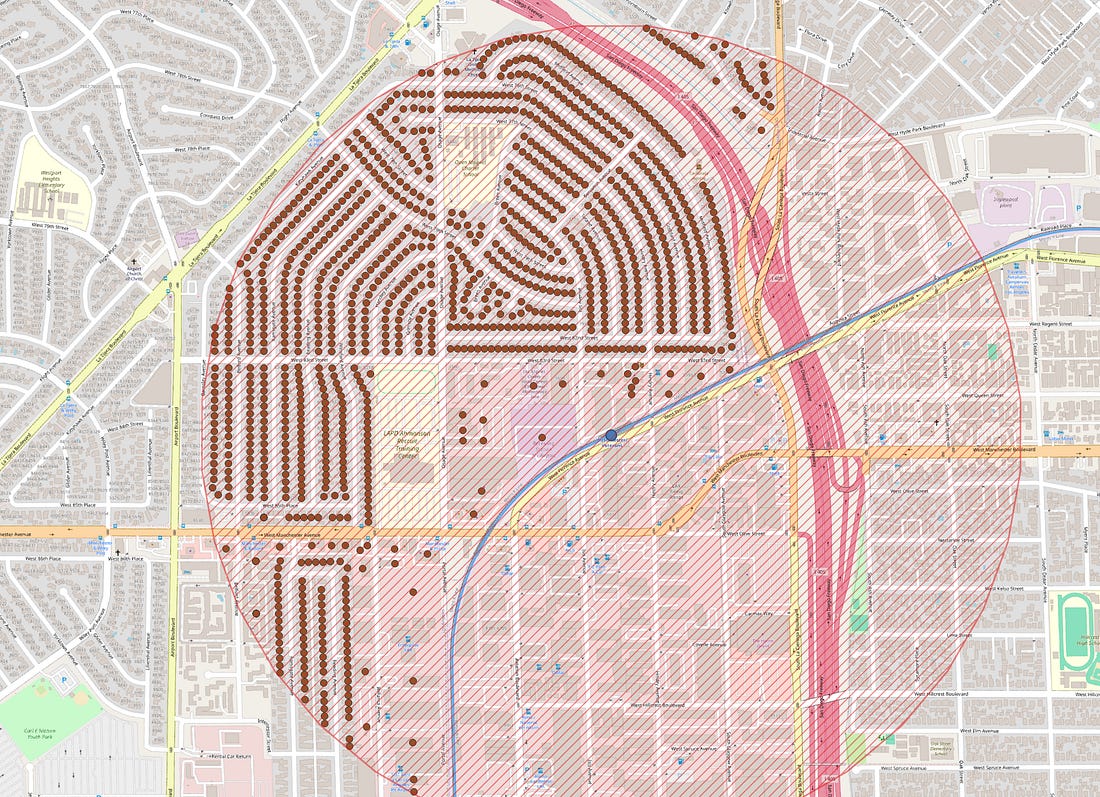
The image below, provided by Westchester resident John Birkett, demonstrates that light rail station rezoning in our community under SB-79 will impact nearly 2200 parcels (inclusive of certain Inglewood parcels), removing them from city oversight and turning them over to corporate developers to target you with incessant offers to buy.Maybe you won’t sell, but how fun will it be to live here when your neighbor does?
This map doesn’t even show you the impacts of the BRT density. Our community will be a hot mess.
And to remind you, these projects will only be built as lots become available, resulting in random middle fingers all over our neighborhood for a very long time. And who exactly is giving up their car to walk to our buses? No, those residents will be clogging our streets with parked cars that may rarely move.
And my new favorite beef — The future is no cars, according to Sacramento; are we all supposed to hop a bus in case of natural disaster?
That’s my rant. Now here are some of the more universally recognized problems with SB-79:
SB-79 bypasses local zoning and local control of development (the projects must be allowed no matter how bad for the community)
The Bill hurts real affordability (older, affordable housing stock will get razed to build market rate high-rise luxury units) (+ lots will be priced for developers, not families when a lot is put up for sale)
Neighborhoods will be disrupted with haphazard density bombs (and infrastructure planning will be nearly impossible by already cash-strapped cities)
Units can be built under this Bill for planned BRT (cities could start “planning” these routes just to generate revenue (developer fees and increased property taxes when properties turn over)
Randomly scattering massive SB-79 projects will not produce thriving, walkable communities
This Bill must be stopped!!!
Headwinds For Defeat
Defeat of this Bill is going to take all of us! The Bill is being called “housing near transit hubs” which sounds very benign, so apathy could easily win the day on this fight.
Another issue is Scott Wiener’s power. He needed 21 votes to get this Bill out of the Senate, and only had 20. He held the vote open and strong-armed a last minute 21st vote. He has power and money behind him. Additionally, Wiener is Chair of the Budget Committee and we all know that Mayor Bass (and other mayors) will likely look to him for money.
Further, the YIMBYs are a well-financed machine pushing all these housing bills based on a false narrative that we have a housing crisis (when in fact, the crisis is affordable housing, not market rate housing like SB-79 pushes).
It is going to take every one of us pushing on our electeds to defeat this Bill.
The Fight Ahead
The Senate is done with its version of the Bill, passing it to the Assembly to vote on. The Bill will work through a couple of Assembly committees and then on to the full Assembly for a vote. If the Bill is amended, it will go back to the Senate for another vote.
The Legislature is currently on Summer break, but will return to pick this Bill up again in late August, making right now the perfect time for everybody to write your Assemblyperson in their local office to tell them the Bill is stupid and that you’ll actively campaign against any elected who doesn’t vote NO.
I’ve been out in the neighborhood since early Spring speaking out about the threat posed by SB-79. I thought I’d pen a quick post outlining what is in the bill (in broad strokes).
And to keep this post relatively neutral, I’ve enlisted Google AI to summarize the bill. I’m not a certified expert on SB-79 by any stretch of anybody’s imagination, but I know enough about it to recognize and confidently represent that the information provided is generally reliable. The cited sources are certainly legit.
Neutral Summary
SB-79, also known as the Abundant & Affordable Homes Near Transit Act, is a California bill aimed at increasing housing near public transit by allowing denser, taller buildings around transit stops. The bill does not mandate affordable units but makes them eligible for incentives. [1, 1, 2, 2, 3, 4, 5]
Key Provisions of SB-79:
Transit-Oriented Development (TOD): SB-79 focuses on transit-oriented development, encouraging housing construction near transit stops. [1, 2]
Increased Density and Height: The bill allows for taller buildings (up to 7 stories near high-frequency transit) and higher densities near transit stops, potentially upzoning areas previously zoned for single-family homes. [1, 6]
Tiered Approach: The level of density and height allowed varies based on the type and frequency of transit service at a given stop. [4, 7]
Streamlined Approvals: SB-79 allows certain developments near transit to utilize the streamlined ministerial approvals process under SB 423. [1]
Flexibility for Local Jurisdictions: While establishing statewide standards, SB-79 allows local governments some flexibility in tailoring their TOD areas and standards. [1]
Focus on Transit Agency Land: The bill encourages development on land owned by transit agencies to generate revenue for public transit. [8]
Affordability Provisions:
Incentives for Affordable Units: SB-79 does not mandate affordable units, but it does make developments that include affordable units eligible for density bonuses and other concessions under existing state law, such as SB 1511. [1, 1, 4, 4, 9, 10]
Potential for Affordable Housing Development: By streamlining the development process and allowing for increased density, SB-79 aims to facilitate the development of more housing overall, potentially including more affordable units. [1, 1, 2, 2]
Tenant Protections: The bill includes tenant protections, such as the right of return for those displaced by development. [2, 2]
Arguments for SB-79:
Addresses Housing Shortage: Proponents argue that SB-79 is crucial for addressing California’s housing crisis by increasing the supply of housing near transit.
Reduces Traffic Congestion: By encouraging people to live near transit, the bill aims to reduce reliance on cars and alleviate traffic congestion.
Promotes Environmental Sustainability: Reduced car usage contributes to lower greenhouse gas emissions and improved air quality.
Supports Public Transit Funding: Development on transit agency land can generate revenue for public transit systems. [2, 8]
Arguments Against SB-79:
Concerns about Single-Family Neighborhoods: Some residents and community groups are concerned about the potential impact of increased density and height on existing single-family neighborhoods. [9]
Potential for Displacement: Concerns exist about the potential for displacement of existing residents as a result of increased development near transit. [2, 9]
Impact on Local Control: Some argue that SB-79 undermines local control over land use decisions. [11]
Current Status:
As of June 3, 2025, SB-79 has passed the Senate and is awaiting further action in the Assembly.
The bill has been amended several times and is subject to ongoing debate and negotiations. [3, 3, 12, 12, 13]
Of course “abundant & affordable homes near transit” sounds like a no-brainer. Hat tip to the highly paid marketing consultant who came up with that title.
But the title is BS.
The bill encompasses parcels within one half mile of “planned transit.” What?
Yes, if a qualifying bus line is “planned,” developers can snatch up lots in a 1/2 mile circumference. Color me skeptical (or a conspiracy nut, if you must), but this smells to me like “planned” bus lines might become something a cash strapped city “sells” to developers.
But even existing bus lines will annihilate existing neighborhoods like Kentwood, being surrounded on three sides by major boulevards with qualifying bus routes.
And don’t even get me started on what Osage becomes with a light rail station.
And how is 1/2 mile “near” to transit?? Do you know anybody who will walk 1/2 mile to our crappy bus system? Even my husband, who is the ONLY person I know who rides the bus, gets in his car and drives down to a park and ride, where he parks mere steps from his bus downtown.
And nothing affordable has to be built. Throwing in a few token units get extra density. 😱
And there are no guardrails to prevent already affordable housing from getting razed for SB-79 market rate units, also known as “gentrification.”
Recent amendments to the bill provide “tenant rights” by allowing displaced people access to the new units, but where are they supposed to go in the meantime, and how are they supposed to afford the resulting market-rate units?
No, those “tenant rights” are lip service and downright offensive.
SB-79 has zero redeeming qualities. Call your assemblyperson stat and let them know you oppose SB-79, and that you will actively campaign against them if they support the bill.
This article first appeared in The Hometown News in May 2024
By Tracy Thrower Conyers
For almost a year we’ve been in an uproar in our community over our Community Plan Update (“CPU”). The update process started out normal enough in 2019, with lots of community engagement opportunities and a first draft that raised eyebrows with what felt at the time like extensive upzoning along Manchester. Those were the “good ole days.”
Fast forward to today, and the third draft of our CPU was recently released. We all breathed a sigh of relief because we had to fight hard, but most of what our community asked for was reflected in the new draft.
But the CPU is just the zoning aspect of the bigger density plan. The builder incentives to exploit that zoning is part of another program called the Citywide Housing Incentive Program (“CHIP”), an 85-page document outlining loads of density incentives for builders.
CHIP consists of three programs: (1) the State Density Bonus Law, (2) the Mixed Income Incentive Program (“MIIP”) and (3) the Affordable Housing Incentive Program (“AHIP”). The CPUs, CHIP and three other ordinances constitute LA’s Housing Element.
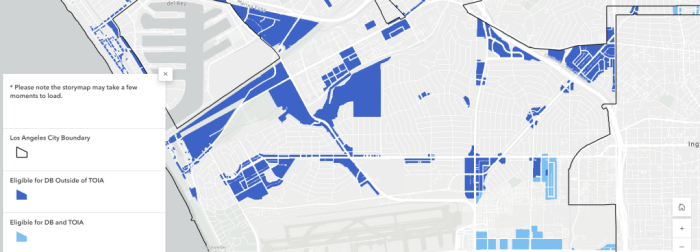
The city provides a visual of the potential CHIP impacts in a series of maps (link at the bottom). In our plan area, the Density Bonus Map and the AHIP Map are something to be watched, debated and likely pushed back on. These projects are coming to any lot near you that isn’t zoned R-1.
The State Density Bonus Program is for projects with 5+ residential units and offers developers a density increase of 35% and a reduction in parking requirements, as well as a menu of other options including increased height, increased floor area, increased lot coverage and reductions to setbacks, yard size, open space and lot width requirements. Off-menu requests will be entertained as well.
The program is complicated and subject to extra incentives with bonus transit incentives, but the percentage of affordable units required to qualify can be as low as 15-20%. These projects are the most troublesome because they represent a lot of burden to neighbors and infrastructure in exchange for not so many affordable units.
The AHIP Program is easier to support in principle for its affordable units, but is still a program to be scrutinized. Specifically, churches and parking lots have special incentive programs that can lead to high rise density projects in the heart of our neighborhoods. These projects get extra density, floor area ratio increases, reduced parking and increased height, and only have to deliver 80% affordable units. And let’s not forget that schools, with their declining enrollment, could be put up for development, according to the map.
CHIP was initially proposed by the Planning Department for single family neighborhoods, but community backlash caused Planning to pull the plug in October on pushing these programs for R-1 lots. The maps are eye opening because it’s easy to assume all the lots around you are zoned just like yours. So take a look to see what is proposed near your home on a lot you never thought could be a high rise apartment building (like the R-2 duplex that backs up to my own lot).
CHIP is not a done deal yet. We still have time to push back. It was supposed to be in Environmental Review in Winter 2024, but I haven’t seen any indication of that yet. After the review, a revised draft will be issued and then there will be a public hearing, followed by Planning Commission, Land Use Committee and City Council hearings, culminating in a City Council vote for approval.
To keep abreast of changes to our CPU and the Housing Element, join the Neighborhood Council’s Community Plan Update Ad Hoc Committee for monthly meetings on the fourth Monday of each month. Find meeting details at www.ncwpdr.org.
Tracy Thrower Conyers is a member of the Neighborhood Council of Westchester/Playa’s Community Plan Update Ad Hoc Committee and a resident of the Kentwood neighborhood in Westchester.
Christopher LeGras, Co-Director of KeepLAMoving, was just added to the agenda for Tuesday’s Neighborhood Council Meeting. Find the agenda here.
The meeting is in person at the Municipal Building at 7166 Manchester Ave and starts at 6:30.
Chris was asked at the last minute to come out and help our community understand the implications of HLA, a measure I personally call “Hello Road Diets.” Read more about HLA here. Please come out Tuesday to show Chris we appreciate his work opposing the measure.
You can also read what other neighbors are saying about HLA on my recent NextDoor post.
KeepLAMoving is the leading pro-mobility group in Los Angeles. A true grassroots group, KLAM advocates for smart transportation policy, public safety, and a rational transit system. They are leading the charge against Initiative HLA, which would create chaos and carnage on L.A. streets.
This post refers to a time-sensitive topic. Ballots have already been delivered. Please read now and share with 10 friends.
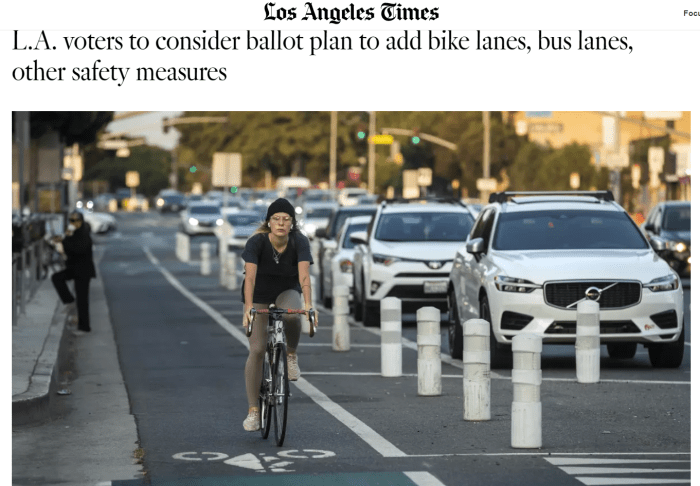
Measure HLA, also referred to by proponents as Healthy Streets LA, asks voters to require the city to redesign streets to be safer for pedestrians and bicyclists. Sounds like a good thing, right?
What isn’t readily apparent is that the law will be tied to the Mobility Plan, a plan that is so controversial and expensive, our city council has all but ignored it since adopted in 2015.
If approved, Measure HLA would require the city to implement a street modification as laid out in the Mobility Plan whenever there’s an improvement to at least 660′ (1/8 mile) of a road or sidewalk.
Effectively, this measure will result in either unimproved streets (😱) or road diets (😱😱😱). I call the Measure “Hello Road Diets.”
Proponents have poured almost $2M into their campaign, including huge billboards at high accident locations. Oh that should help the accident rate. 🙄
Opponents have spent $0, relying on grassroots and social media.
One of my good friends in our community who works tirelessly, but anonymously, bugged me for weeks to jump on this measure. Honestly, I’m still kind of burned out from all the work we did opposing the last draft of the Community Plan Update, so I was slow to jump on.
But she sent me a description of the measure written by Chris LeGras, co-director of the leading voice in opposition to HLA. I readily saw the implications of the bad measure and swooped into action with a post on NextDoor. In just a few days, that post got 42 comments and 31 reactions, overwhelmingly in opposition to HLA and its mandatory road diets.
It’s easy for us to understand the implications. We lived through the short-lived PdR Road Diet and are still living with the Mar Vista Road Diet. I’m confident how our community will vote if they understand the mandatory Road Diets that come with HLA. I’m more concerned about the rest of the City and voters with no idea what a Road Diet looks like and how disruptive it will be.
Disruptive and expensive. In fact, our Councilwoman introduced a motion to the City Council on Wednesday asking for an analysis of the financial implications of the measure, if passed.
Go figure. Some group can put a measure on the ballot with a lot of happy talk, manipulate voters to support it and the city is left with the tab. Sound familiar? It’s 100% the playbook Sacramento has been using recently with housing policy and housing laws.
If it’s more than our budget can support, new taxes are headed our way.
Look, we all agree that any death is one too many, but HLA is a sledgehammer for an ant (and an expensive sledgehammer at that). There has to be a more measured and reasonable way to address the fatality issue.
Please help me spread the word about this measure. Ballots are already in the hands of voters. Please share this post with 10 friends and ask them to do the same. Share it on your social media. Shout it from the rooftops. Please. 🙋♀️🙋♂️